Designing places for growth: Masterplanning energy and innovation campuses
The UK's transition to a low-carbon economy is driving unprecedented investment in energy infrastructure, research and development facilities, advanced manufacturing and innovation-led employment sites. From clean energy clusters and science parks to technology campuses and industrial innovation districts, Senior Urban Designer, Amy Whitten explores how these developments are increasingly expected to deliver far more than floorspace alone.
As the scale and complexity of these projects increase, so does the importance of masterplanning. The most successful schemes are no longer defined solely by their operational performance or technical capability. They are places that attract talent, foster collaboration, support long-term investment and respond flexibly to future change.
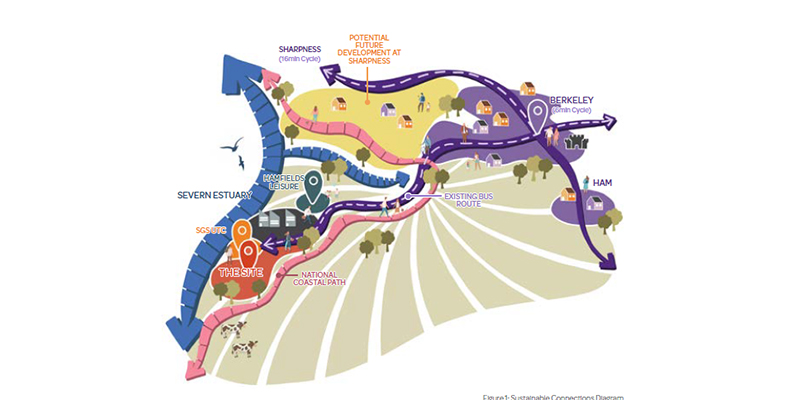
Our experience supporting the redevelopment of Berkeley Green Science & Technology Park highlights several important lessons for the planning and design of next-generation energy and innovation campuses.
Placemaking matters – even in industrial environments
Historically, employment and industrial developments have often prioritised operational efficiency above all else. However, the expectations of occupiers, investors and employees are shifting.
Innovation-led businesses compete globally for talent and the quality of the working environment influences investment decisions, employee satisfaction and business growth.
As a result, successful campuses are being designed as destinations rather than simply places of work. This means creating environments that support collaboration, wellbeing and identity through high-quality public realm, attractive landscapes, coherent movement networks and opportunities for social interaction.
For research, technology and clean energy sectors in particular, the physical environment plays a critical role in encouraging knowledge exchange and innovation between organisations. In this context, placemaking is not supplementary to commercial success; it is one of its primary enablers.
Building flexibility into the framework
One of the greatest challenges facing innovation and energy developments is uncertainty.
Technologies evolve rapidly, market demands shift, occupier requirements change over time. A masterplan that is overly prescriptive at the outset can quickly become outdated.
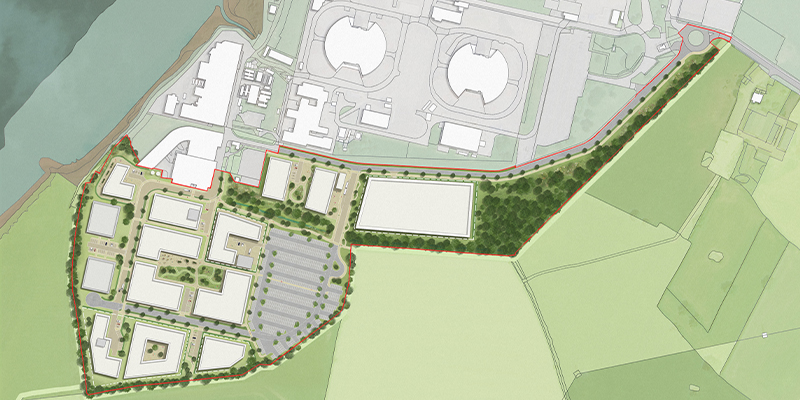
Berkeley Green Science & Technology Park Masterplan
Successful masterplans establish a robust framework rather than a fixed end state. They provide enough certainty to support investment and planning delivery while retaining sufficient flexibility to accommodate future technologies, changing business needs and evolving development opportunities.
This is particularly relevant for research and development campuses where future occupiers may not yet be known and where technological advancement can significantly alter spatial requirements over the lifespan of a project.
Heritage as a catalyst for identity
Many energy and industrial sites possess a rich history that has shaped their local communities and economies. Too often, heritage is viewed solely through the lens of constraint. In practice, heritage assets can become powerful placemaking tools.
The most successful regeneration projects recognise the value of existing site narratives, historic structures and cultural associations. Heritage assets can anchor a campus in its local context, creating a distinctive identity that differentiates it from competing locations and enhance community engagement.
Delivering places for the long-term
The transition to a net zero economy will require a new generation of employment and innovation environments. These developments must accommodate complex operational requirements while also attracting investment, supporting collaboration and creating places where people want to work.
The most successful energy and innovation campuses are those that combine strategic infrastructure planning, flexible development frameworks with strong placemaking principles and an authentic identity.
Achieving this balance requires more than technical expertise alone. It relies on an iterative, collaborative masterplanning process that brings together clients, stakeholders, technical specialists and communities around a shared vision. As sites become increasingly complex and technologies continue to evolve, this co-design approach will remain fundamental to creating resilient, adaptable and investable places capable of supporting innovation and growth for decades to come.
For further insight into how we can support the masterplanning and delivery of energy and innovation campuses, please get in touch with Amy Whitten or Niamh Hession.
Turley
has
secured
approval
for
two
major
residential
developments
in
Derry~Londonderry,
delivering
more
than
700
new
social
homes
alongside
community
and
...