Wastewater constraints could cost Northern Ireland’s economy £10.9bn in 2040, new report informed by Turley and OCO Global research warns
The Wastewater Infrastructure Group has launched a major Stormont report combining research undertaken by Turley and OCO Global - warning that we need a collective response that meets the scale of challenge.
Building on last year’s joint position paper which was supported by findings of reports undertaken by Turley and Grant Thornton, the major new report released by the Wastewater Infrastructure Group (WIG) has warned that Northern Ireland’s wastewater infrastructure constraints are now acting as a significant brake on housing delivery, investment, regeneration, and long-term economic growth.
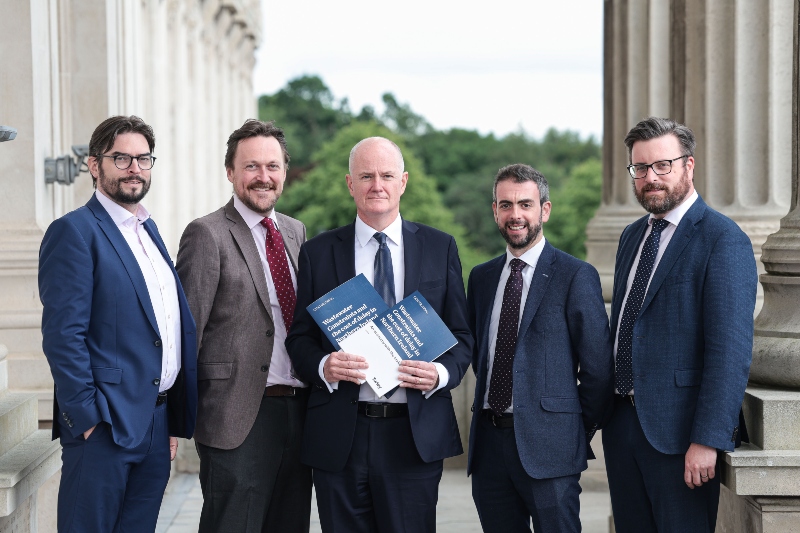
The report, entitled Wastewater Constraints and the Cost of Delay in Northern Ireland: An Economy with the Brakes On, was launched at The Long Gallery, Parliament Buildings, Stormont, on Wednesday 1 July 2026.
The report estimates that if current wastewater constraints continue, Northern Ireland’s economy could be £10.9bn smaller in annual GVA terms by 2040 than it would be if the infrastructure capacity needed to support growth is delivered.
Within this model, households in Northern Ireland would on average be £2,750 per annum worse off, with economic impact growing over time, from £325 per household in 2028, to £3,085 in 2035 and £5,500 in 2040.
It used an economic model, prepared by Andrew Webb, lead economist at trade and investment advisory firm OCO Global, combined with research and case studies from Turley.
Left-Right: Andrew Webb (OCO GLobal), Justin Cartwright (CIH), Mark Spence (CEF), Stuart Anderson (NI Chamber), John Davison (Turley)
The report also highlights that around 55,000 homes are currently understood to be impeded by some level of wastewater capacity constraints. It warns that the impact is not limited to housing, but extends across construction, regeneration, employment land, town centre growth, private investment, and environmental recovery.
The Wastewater Infrastructure Group says the findings demonstrate that wastewater constraints are not simply a utility or environmental issue, but a core economic infrastructure challenge for Northern Ireland.
Speaking about Turley’s role in the report, John Davison, Director, Head of Strategic Communications said:
“This report makes clear that wastewater capacity is no longer a technical issue sitting in the background of development; it is now one of the biggest barriers to delivering the homes, jobs and investment Northern Ireland needs. When infrastructure cannot keep pace, development is stalled or stopped altogether. That means fewer homes being built, including social and affordable homes, more pressure on supply, higher house prices and rents, and a weaker economy.
“That is why the Wastewater Infrastructure Group is calling for a sustainable, long-term funding settlement for PC28, the next price control period that will determine the capital infrastructure investment available to NI Water from 2028 to 2033. The Northern Ireland Executive must fully fund PC28 if we are serious about unlocking housing delivery, supporting regeneration, enabling business growth and protecting the environment. Turley has been pleased to help co-ordinate the activity of this group, bringing together housing, construction and business voices around a clear shared message: without sustained investment in wastewater infrastructure, Northern Ireland’s growth ambitions will remain constrained.”
Mark Spence, Chief Executive of the Construction Employers Federation, on behalf of the Wastewater Infrastructure Group said:
“Wastewater infrastructure is now one of the most significant constraints on Northern Ireland’s construction sector. This is not simply about pipes and treatment works. It is about whether we can build the homes people need, support business growth, regenerate our towns and cities, and protect our environment.
“The report shows that the cost is real and growing. Around 55,000 homes are understood to be impeded by some level of wastewater constraints, while our modelling indicates that Northern Ireland’s economy could be £10.9bn smaller in 2040 if we continue on the current path where the funding received for wastewater infrastructure is less than that established by the Utility Regulator.”
While the report recognises recent progress, including around £30m of additional monitoring round investment to unlock almost 5,300 new homes since autumn 2024, it warns that these interventions are not be sufficient to meet the scale of the challenge.
Suzanne Wylie, Chief Executive of NI Chamber added:
“The cost of wastewater constraint to Northern Ireland’s economy is already being felt through delayed homes, deferred investment, higher housing pressures, and weaker confidence in delivery, but what this report demonstrates is the extent to which it may limit the scale of our growth as a region. That should focus minds.
“We support the progress that has been made, including funding allocations that have helped unlock new homes in parts of Northern Ireland. However, the scale of the challenge now requires cross party agreement for a strategic, long-term, and properly funded response – meeting the capital requirements set by the regulator established through the price control mechanism that establishes the funding requirements for NI Water.”
The report calls for a funded, multi-year approach to wastewater infrastructure, including strategic investment in NI Water, delivery of Sustainable Urban Drainage Solutions legislation, the use of voluntary developer contributions to supplement infrastructure investment, and a clearer long-term funding model capable of supporting housing, economic growth, and environmental improvement.
Justin Cartwright, Northern Ireland Director at the Chartered Institute of Housing, concluded:
“Northern Ireland can continue to manage constraint – leaving thousands on housing waiting lists - or it can choose recovery and growth. With the right funding model, clear delivery plan and political commitment, wastewater infrastructure can become an enabler of growth, housing, environmental improvement and regional balance.”
The Wastewater Infrastructure Group includes NI Chamber, Construction Employers Federation, Chartered Institute of Housing, Northern Ireland Federation of Housing Associations, Manufacturing Northern Ireland, Northern Ireland Retail Consortium, and the Institute of Directors (NI).
The full report is available to download below. For more information, please contact John Davison.
Download
Wastewater Constraints and the cost of delay in Northern Ireland: July 2026