Comment
A look ahead to the local elections in London 2026
On 7 May 2026 local elections will be held across England, with elections also taking place for the Scottish Parliament and the Senedd respectively. In London, all 32 boroughs will be in contention with all seats up for grabs. In this article we focus on England’s capital city, with Assistant Consultant, Strategic Communications, Philip Sellar, exploring what happened in 2022, the events since and emerging trends following the General Election, before looking towards May and the boroughs of interest for each of the major parties.
In the May elections, 4,992 seats across 136 local authorities in England will be contested. Labour holds around 2,196 of them, the Conservatives with 1,334, the Liberal Democrats on 663, Greens on 170 and Reform with 78. The remainder is made up of local parties and independents.
Across London, if current trends continue to election day, Labour is set to face significant losses with challenges from their left and right. London will not be immune to the continued fragmentation of the established two-party system of Labour vs Conservative, with the emergence of Reform UK and the Green Party.
The last set of local elections in London were held in May 2022. The country was slowly emerging into a post-Covid world and whatever “vaccine bounce” the Conservative Government enjoyed the year prior (despite being in power for over a decade) was at an end, with the Government being embroiled in a series of scandals including “partygate”.
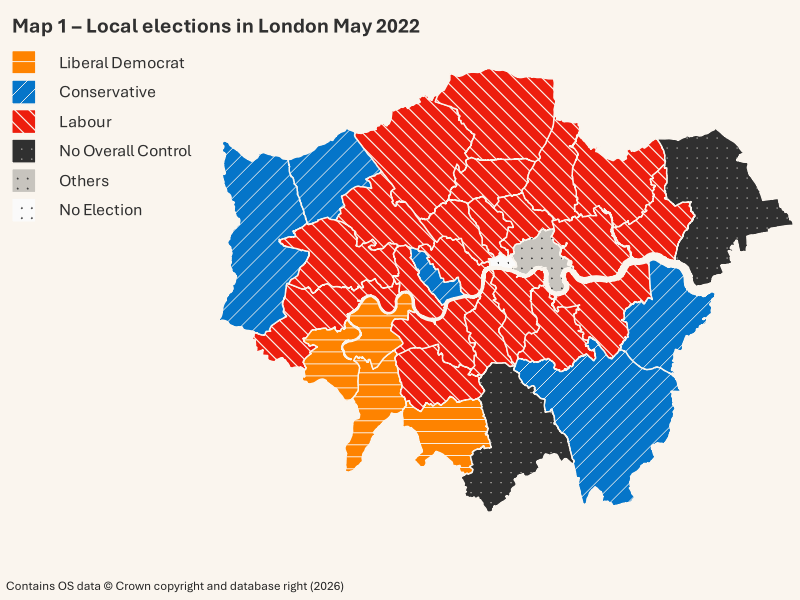
The Government was dogged by this throughout the campaign and would ultimately pay the price at the ballot box, continuing a trend of Conservative decline in the capital. The Conservatives won 404 seats on 25% of the vote and control of the following authorities: Bexley, Bromley, Harrow, Kensington and Chelsea. Notably, they lost Barnet, Wandsworth and Westminster, long standing Conservative councils. In the case of Westminster, it was the first time that the council went to any party other than the Conservatives since the local authority’s modern establishment in 1965.
This left the Conservatives with their lowest number of councils in the capital since 1998 and down from controlling seven London authorities in 2018, and going further back, nine local authorities in 2014 when Boris Johnson was in the middle of his second term as Mayor of London.
Labour, on the other hand, had a good election with the party winning 1,156 of the 1,817 seats across London on 40% of the vote. They were the main beneficiaries of the Government’s unpopularity, which resulted in straight switching of the local authorities from Conservative to Labour.
For the other parties, this election showed the continued consolidation of Liberal Democrat support around South West London (Richmond, Kingston, Sutton) and the continued dominance of local parties in certain boroughs such as Aspire in Tower Hamlets and the Residents Association in Havering.
As a sign of how the political landscape has radically changed in recent years, the Green Party won 18 seats across London on 11% of the vote, while Reform UK barely registered.
Local elections in London May 2022
Politics in London since 2022 - the Mayoral and General Election
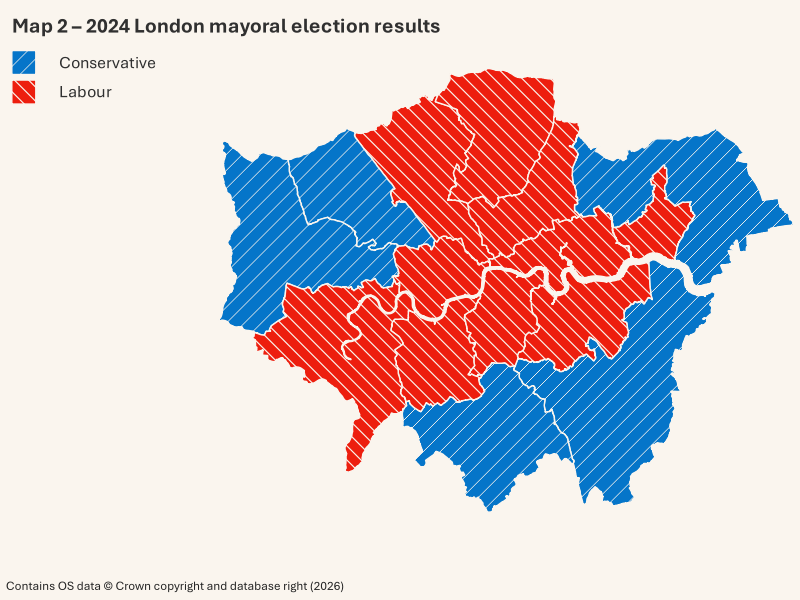
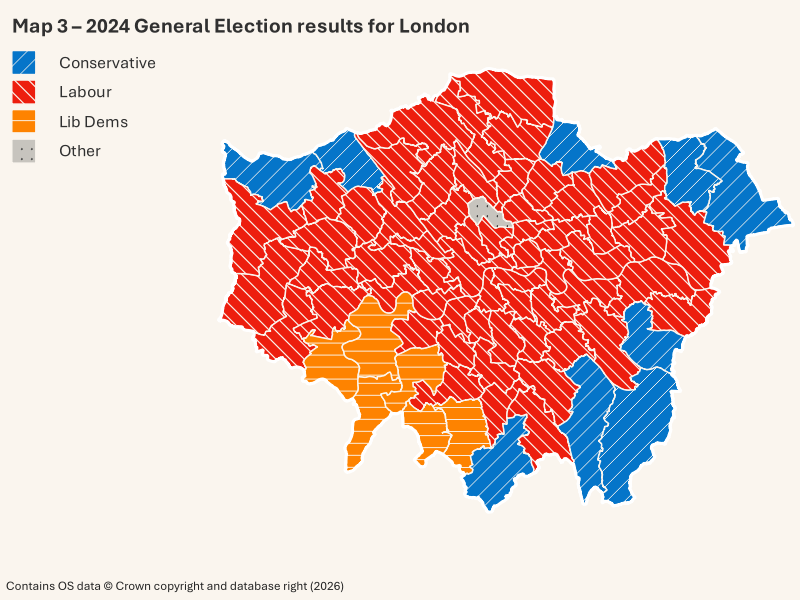
Following the 2022 local elections, Londoners have been to the polls for the mayoral election in May 2024 and the General Election in June 2024. These elections were electoral successes for Labour, with Sadiq Khan elected to an unprecedented third term as Mayor of London, and at the General Election winning 59 of the 75 seats followed by the Conservatives on nine, the Liberal Democrats on six and Jeremy Corbyn becoming an Independent MP after winning his constituency from Labour.
2024 London mayoral election results
2024 General Election results for London
Nationally, Labour ended 14 years of Conservative Government and won a landslide majority on an electorally low share of the vote. Psephologists attribute the result of the fragmentation of the two-party system, with voters who were dissatisfied with the Conservatives voting for alternatives such as Reform, the Lib Dems or Greens.
Politics in London since 2024
Labour, despite winning a substantial majority in parliament, has not enjoyed the “honeymoon period” that a new Government typically receives from the public, with a mixture of unpopular policy decisions and repeated U-turns affecting perceptions (a visual summary of national opinion polling can be seen at this link[1]). Furthermore, the “growth agenda” the Government has pursued is yet to materialise for the public, with various economic forecasts showing modest levels of growth for the remainder of the parliament.
Sir Keir Starmer is currently the most unpopular Prime Minister since opinion polls started to cover favourability, and so is the Government.
Labour are going into these elections as the largest party in London, with over 60% of the seats. They have the most to lose, but what makes this election unprecedented is that they will be up against established opponents (the Conservatives and Lib Dems), as well as the new challenger parties (Reform and the Greens) and even local parties that are targeting parts of their voting coalition e.g. Aspire, Independent groupings, etc. They are effectively facing challenges right across the political spectrum.
In the past, the Conservatives could have expected to be the main beneficiaries of Labour’s woes. However, polling suggests that the public still remember the tail end of the last Government and the various U-turns, scandals and public in-fighting that beleaguered a succession of Conservative Prime Ministers.
Dissatisfaction with the established major parties has opened the field to challenger parties, namely Reform and the Greens.
For Reform, the party has gone from strength to strength. At the last general election, the party registered over four million votes (which was more than the Lib Dems). However, due to the quirks of the First Past the Post (FPTP) system, they only returned five MPs, which included Nigel Farage in Clacton. Since then, the party appears to have been the main beneficiary of dissatisfaction with the Labour Government and the Conservatives. We also have evidence for their growing support by looking at last year’s local elections where the Conservatives were the party with most to lose. That election saw the Conservatives lose 674 councillors, followed by Labour with 187 councillors. Reform topped the poll with 677 gains and a vote share of 30%. The first time they have hit that level of vote share at any national election. Since then, Reform has maintained a consistent lead across national opinion polls, with some forecasters suggesting that if an election was held tomorrow, Reform would be well placed to form the next Government. Their reach is not limited to England, with the party vying with Plaid Cymru to become the largest party in the Senedd, and in a battle with Scottish Labour to become the main opposition party in Holyrood.
When it comes to London, the party is polling lower than the national average. Spokespeople from the party and some commentators point to the Outer London boroughs being the main targets for the party to make a breakthrough in. These boroughs also tend to be some of the last remaining Conservative-controlled councils in the capital - Hillingdon, Bexley and Bromley. Havering (on the Essex border) is also another borough being talked up by Reform. Perhaps an indicator of where things are trending there includes the recent defection of the Romford MP Andrew Rosindale and London Assembly Member Keith Prince to Reform from the Conservatives. Pollster Lord Hayward has noted that in most cases, these areas share similar demographics to Kent and Essex, areas where Reform is performing strongly compared to the rest of the country.
Reform is not the only challenger party to have emerged since the general election. The Greens performed modestly at the last election with around 6% of the national vote. However, a mixture of targeting and pushing tactical voting campaigns (usually at the expense of the Conservatives) saw them triple their representation at Westminster with four MPs. Since then, there has been a change of leadership with the election of Zack Polanski in September 2025. Polanski, who has been a member of the London Assembly since 2021, appears to be moving the party from a focus on environmental issues towards providing a broader left-wing alternative to those voters who went with Labour and are now disillusioned with the direction of the party. The party has seen its membership rise from 65,000 to reportedly over 100,000 in the months since. In the opinion polls the party is performing in the mid-teens, and at the end of February managed to win Gorton and Denton, a seat which was one of the safest Labour parliamentary constituencies in the country.
Like Reform, the Greens will be going into these local elections with little to no electoral record in many of the wards they will be contesting in and will likely go about a very demographically targeted campaign. Targeting voting groups that Labour could typically rely on, such as students, young professionals and communities that might feel disillusioned, there is also the important issue of ongoing conflicts in the Middle East. In a London context, the Greens will be looking to target certain inner city London boroughs. Many of these boroughs have been dominated by Labour for decades and face little to no substantial opposition. Boroughs mentioned by psephologists such as Sir John Curtice include Lambeth, Lewisham, Hackney, and Newham. Indicating that these places are of interest to the Greens, are reports in the media that Zack Polanski is reportedly considering standing in constituencies such as one of the Hackney seats, Tottenham or Walthamstow.
As for the Liberal Democrats, the party has a reputation for successfully embedding itself in local government once it has made a breakthrough. In the case of London, these areas are around the South West of London, with non-existent opposition parties on Richmond or Kingston Councils. For them, the most competitive borough will likely be neighbouring Merton, which in recent years has been a battleground for Labour, the Conservatives and the Lib Dems. At the last local elections, the Lib Dems for the first time became the main opposition on the council (displacing the Conservatives) and at the 2024 General Election the party gained the Wimbledon constituency from the Conservatives for the first time. Labour has maintained control of the council since 2010, but the Lib Dems will be hoping that the unpopularity of the Government nationally will translate to votes here. Other areas the Lib Dems are reported to be looking at increasing representation are those areas in London where historically the party did have a presence but suffered under the coalition years. Areas cited include Southwark (once represented in parliament by Sir Simon Hughes), Haringey, Camden and Islington.
Finally, what is perhaps the biggest unknown in these elections will be the electoral impact on independent groupings in some boroughs. These groupings appear to have mobilised as a result of dissatisfaction with Labour, namely how the Government has positioned itself on the conflict in Gaza. A number of Independent MPs were elected in areas with high Muslim populations in 2024, and it remains to be seen if this trend will continue into May. If it does, the impact should be most noticeable in boroughs like Newham, Redbridge, and Waltham Forest.
Final thoughts
Tending to err on the side of caution, my personal opinion is that we won’t see many clearcut switches from one party to another across the capital. Apart from the handful of actual Conservative/Labour competitions, I believe the more likely outcome will be Reform or Green representation appearing on numerous councils for the first time and for more authorities to be under a state of no overall control, meaning coalition building and agreements being made between two or more groupings. While Labour is struggling, we should not understate the decades of dominance the party enjoys in some areas and the implications this has.
Nationally, the political commentariat widely believe these elections will be disastrous for Labour. However, whether this will be the final event that makes the various leadership hopefuls finally make their move and challenge Sir Keir Starmer remains to be seen…
For more insights on the political situation in London ahead of the local elections, please contact Philip Sellar.
1 April 2026
You may also be interested in
News
13 February 2026
Turley secures planning permission for the redevelopment of Claverings Industrial Estate in north London
Following unanimous approval by Enfield’s planning committee, permission has been granted for the redevelopment of an existing, outdated industrial estate to ...